Free 1893 Barber Dime Value Calculator
Select your mint mark, condition, and any known error variety, then click Calculate for an instant value estimate based on current market data.
If you're not yet sure of your coin's mint mark or condition, there's a free 1893 Barber Dime Coin Value Checker tool that lets you upload photos and get an AI-assisted estimate without any numismatic knowledge required.
🔍 1893/2 Overdate Self-Checker
The 1893/2 overdate (FS-301) is the most famous 1893 dime variety. Use this checker to determine whether your coin might carry this premium attribute.
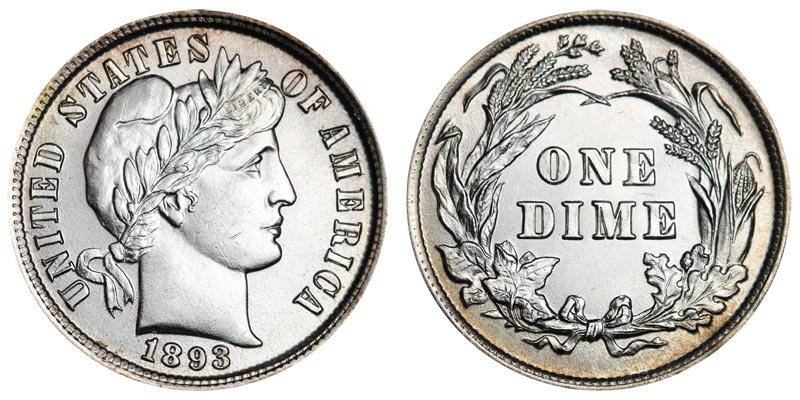
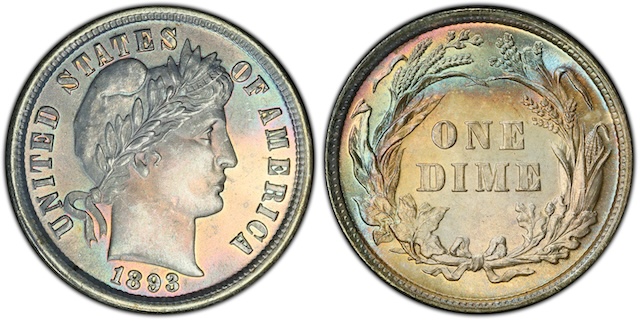
🔵 Regular 1893 Dime
The numeral "3" in the date has a clean, simple curved form with no extra serif, blob, or shadow at its base. The digit terminates cleanly at the bottom. No underlying digit is visible even under 10× magnification. Surface of the numeral shows uniform relief with no doubling or thickening.
⭐ 1893/2 Overdate (FS-301)
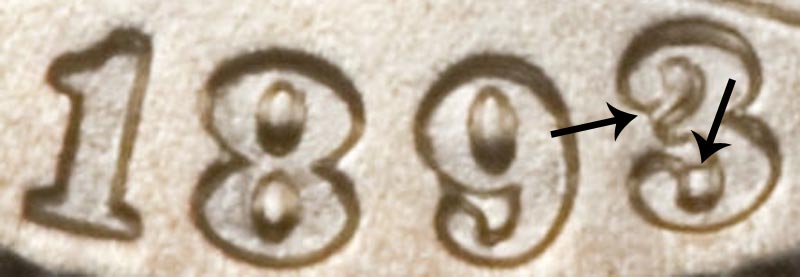
Under 10× magnification the numeral "3" shows remnants of an underlying "2" — specifically a curved serif or blob protruding at the base and lower-right of the digit. The secondary digit appears as a thickening, shadow, or distinct curved element that doesn't belong to a clean "3" form. Die state and strike quality affect visibility.
Check all that apply to your coin's date area:
- Under 10× magnification, the base of the "3" in the date appears thickened or has an extra curved element
- A faint curved serif or blob is visible at the lower-right of the "3" that doesn't appear on other numerals in the date
- The "3" appears to have a shadow or doubling in its lower half compared to the "1", "8", and "9" in the date
- The coin is from the Philadelphia Mint (no mint mark on reverse below the wreath ribbon)
Want a number, not just a yes/no?
The self-checker tells you if you have an overdate. The calculator tells you what it's worth.
📋 What's on This Page
The Valuable 1893 Barber Dime Errors (Complete Guide)
Five distinct varieties and errors separate common 1893 dimes from coins worth hundreds or thousands of dollars. Each card below covers what makes the variety special, how to spot it, and what the market currently pays.
1893/2 Overdate (FS-301)
The 1893/2 overdate originated when Philadelphia Mint hubbers punched date logotypes for 1893 over working dies that already carried the 1892 date. The result is a coin where the underlying "2" survives as ghost imagery within the "3" of the date. CONECA lists this variety as FS-301, and both PCGS and NGC recognize it for attribution.
To identify it, examine the numeral "3" under at least 10× magnification. A genuine overdate shows a curved serif, blob, or secondary element at the base and lower-right of the "3" — remnant curves from the underlying "2" punch. The remaining digits (1, 8, 9) will appear clean by comparison. Die state and strike quality affect how boldly the underlying "2" reads.
Collectors prize this variety because it provides a window into 19th-century die preparation and is one of the most visually compelling overdates in the Barber series. Circulated examples trade for $120–$575 depending on wear, while gem uncirculated pieces can reach $5,000–$16,000. Some experts note that grading services' recognition has fluctuated, so attribution from a reputable numismatist is advisable before purchase.
1893-S/S Repunched Mintmark (FS-501)
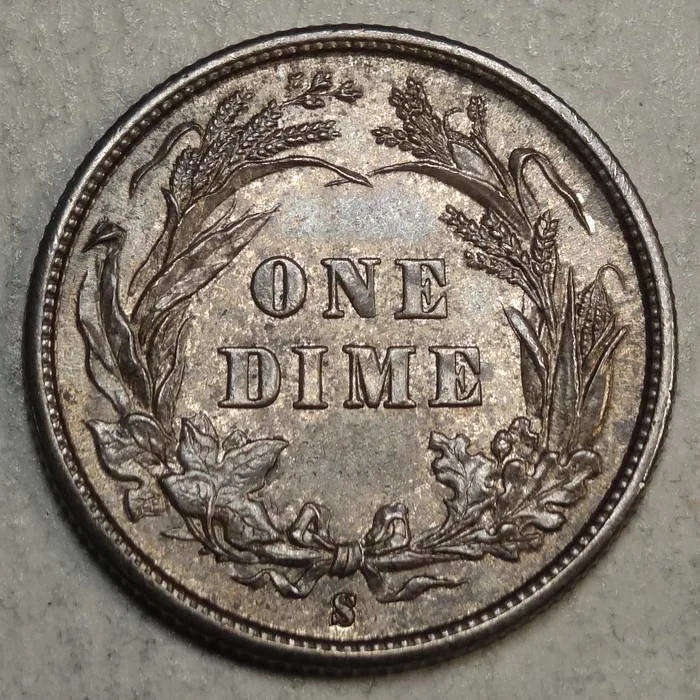
The 1893-S/S repunched mintmark — sometimes called the Triple S — resulted when San Francisco Mint workers applied the mintmark punch to the working die multiple times in slightly different positions. Each application left its own impression, creating a die with overlapping "S" letters that transferred to every coin struck from that die.
Under magnification, the mintmark area on the reverse (below the ribbon tying the wreath) reveals secondary "S" impressions shifted north, south, or at an angle relative to the primary "S." The overlapping curves are distinguishable from die deterioration, which produces a fuzzy, undefined mintmark rather than crisp secondary impressions. Designated FS-501 by CONECA.
This variety commands a meaningful premium over standard 1893-S dimes at all grade levels. In circulated grades like Very Fine, examples sell for $150–$240. About Uncirculated specimens reach $325–$575. Mint State pieces range from $675 to $5,500 based on the sharpness of the mintmark doubling, overall strike quality, and surface preservation. Greysheet CPG lists the variety from $30 in heavily worn grades to $1,850 in gem mint state.
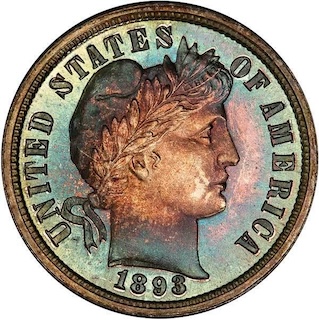
1893 Proof Dime
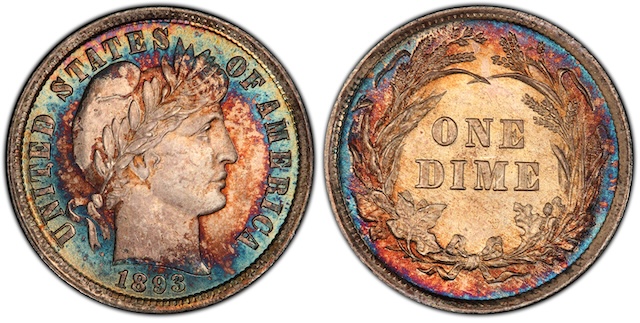
The Philadelphia Mint struck just 792 proof 1893 Barber dimes, all intended for sale to collectors at a premium over face value. These early Barber proofs were produced with painstaking care: dies were polished to a mirror finish, and planchets were burnished before striking. The result is a coin with deeply reflective fields that contrast sharply with the frosted relief of Liberty's portrait — the definition of a cameo effect.
Proof Barber dimes from 1892–1901 are distinguished from business strikes by their mirror-like fields (visible even in photographs), square-edge rims, and sharply defined hair and headband detail that often surpasses that of mint state business strikes. Under magnification, hairlines — microscopic scratches from improper handling — are the most common detractor on surviving proofs. Cameo designations (PF-CAM) require pronounced contrast between frosted devices and reflective fields.
NGC has graded 224 proof examples of the 1893 dime. A PR-63 typically sells for $617–$730 at auction. A PR-67 realized $5,640 at Heritage FUN 2017, while a PCGS PF-68 sold for $11,400 at Stack's Bowers ANA 2021. Deep Cameo examples command a further 50–200% premium over standard proofs at the same numeric grade.
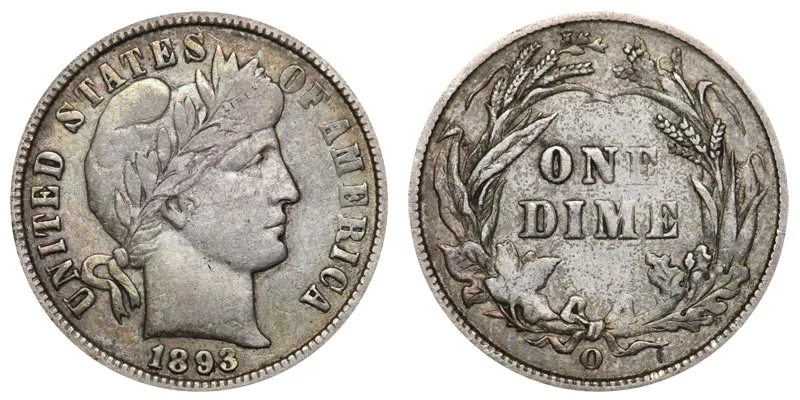
1893-O Barber Dime
The New Orleans Mint struck only 1,760,000 Barber dimes in 1893 — the lowest mintage of the three business-strike issues that year. While not prohibitively rare in circulated grades, the 1893-O becomes genuinely scarce in high uncirculated condition. The Greysheet lists the 1893-O from $16 in well-worn condition all the way to $60,000 at the gem end of the scale.
Collectors and graders must account for a well-documented characteristic of New Orleans Mint dimes: they are frequently softly struck. Weak strike affects the hair detail above Liberty's forehead and the central reverse eagle feathers. A 1893-O with full, sharp LIBERTY on the headband and strong eagle detail is genuinely difficult to find and commands a premium beyond what grade alone would suggest. Prooflike surface specimens (Greysheet: $405–$156,000 for PL examples) are among the most dramatic in the Barber series.
In Good-4 circulated grades the coin trades for approximately $16–$31. Very Fine examples run $65–$120. About Uncirculated pieces reach $300–$600. MS-62 examples have traded for $300–$500 at Heritage. The extraordinary upper end of the Greysheet range reflects gem prooflike specimens — an NGC Top Pop category — that rarely come to market. Assembling a high-grade 1893-O requires patience and budget.
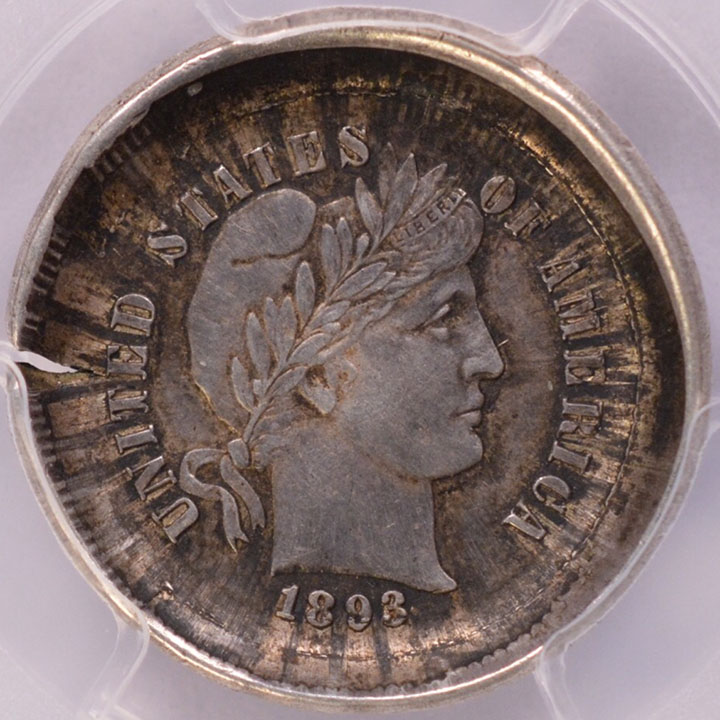
1893 Barber Dime Die Cap Error
The die cap error is the rarest minting mistake documented in the entire Barber dime series. It occurred when a freshly struck coin adhered to the upper hammer die instead of ejecting normally from the press. As subsequent blank planchets entered the collar, the trapped coin — now acting as a temporary die — struck additional blanks, each time deforming further and taking on the characteristic mushroomed, cap-like shape that gives this error its name.
The resulting coin shows a dramatically distorted obverse (or reverse) that has been spread outward and curved from repeated impacts, while the opposite side records the strike as a full-brockage or partial impression. The surface preserved by the die contact shows exceptional detail in some areas, while the edges curl and spread dramatically beyond the coin's normal 17.9 mm diameter. Fewer than 10 examples of this error type are known across the entire Barber dime series spanning 1892–1916.
Due to its extraordinary rarity, this error commands prices that dwarf those of the most valuable regular-strike 1893 dimes. One example graded AU-55 by PCGS sold for approximately $25,000 through a specialist error coin dealer. Even lower-grade examples would likely command $10,000–$15,000 at major auction. Professional authentication by PCGS or NGC is absolutely essential before any transaction, as die cap errors attract sophisticated forgeries and misidentified damaged coins.
1893 Barber Dime Mintage & Survival Data
| Issue | Mint | Business Strike Mintage | Proof Mintage | NGC MS Pop. | Notes |
|---|---|---|---|---|---|
| 1893 (P) | Philadelphia | 3,340,792 | 792 | 165 MS graded | Includes the 1893/2 overdate (FS-301) variety |
| 1893-O | New Orleans | 1,760,000 | — | 211 MS graded | Often softly struck; prooflike examples known |
| 1893-S | San Francisco | 2,491,401 | — | 131 MS graded | Includes 1893-S/S RPM FS-501; auction record $63,250 |
| Total 1893 | All mints | 7,592,193 | 792 | 507 MS total | Business strikes + proofs combined |
NGC population figures are approximate and reflect graded examples only — the true number of surviving coins across all grades is substantially higher. All dates in the Barber series are scarce in grades AU-50 and above.
Found one of these errors on your coin?
Run the calculator above to get an instant value estimate for your specific mint, condition, and variety combination.
📝 Describe Your Coin for a Detailed Assessment
Not sure what you have? Describe your 1893 dime in your own words and our analysis tool will interpret the details and provide a more targeted estimate.
Mention these things if you can:
- Any letter below the wreath on the reverse (O, S, or nothing)
- How many letters of LIBERTY you can read on the headband
- Whether the coin looks shiny/lustrous or dull/worn
- Any visible doubling in the date, especially the "3"
- Whether the coin appears to have mirror-like fields
Also helpful:
- Any cleaning marks, scratches, or environmental damage
- Color: silver-gray, toned dark, or artificially bright?
- Whether it's in a plastic holder (NGC/PCGS slab)
- The eagle details on the reverse — sharp or flat?
- Anything unusual about the date numerals or mintmark
📊 1893 Barber Dime Value Chart at a Glance
Values below reflect current market pricing based on PCGS auction data, Greysheet CPG, and Heritage auction results. For a complete illustrated step-by-step 1893 Barber dime identification walkthrough with photographic examples at every grade, see this detailed 1893 dime value guide and reference breakdown.
| Variety / Issue | Worn (G–VG) | Circulated (F–VF) | XF / AU | Uncirculated (MS-60–63) | Gem (MS-64+) |
|---|---|---|---|---|---|
| 1893 Philadelphia (P) | $14–$20 | $31–$44 | $73–$107 | $165–$350 | $500–$2,000+ |
| 1893/2 Overdate FS-301 SIGNATURE | $120–$170 | $250–$575 | $800–$1,600 | $1,550–$2,200 | $5,000–$16,000+ |
| 1893-O (New Orleans) | $16–$31 | $50–$120 | $200–$600 | $300–$1,800 | $3,000–$60,000+ |
| 1893-S (San Francisco) | $13–$24 | $35–$100 | $180–$500 | $250–$2,300 | $2,500–$63,250 |
| 1893-S/S RPM FS-501 | $30–$60 | $150–$325 | $325–$675 | $675–$1,850 | $2,000–$5,500+ |
| 1893 Proof RAREST | — | — | $330–$500 | $617–$900 | $2,760–$11,400+ |
📱 CoinHix lets you scan your 1893 Barber dime and cross-check its grade against current market comps in seconds — a coin identifier and value app.
🔎 How to Grade Your 1893 Barber Dime
Grading is the single biggest factor in 1893 dime value. LIBERTY on the headband is the key diagnostic — here's what each condition tier looks like.
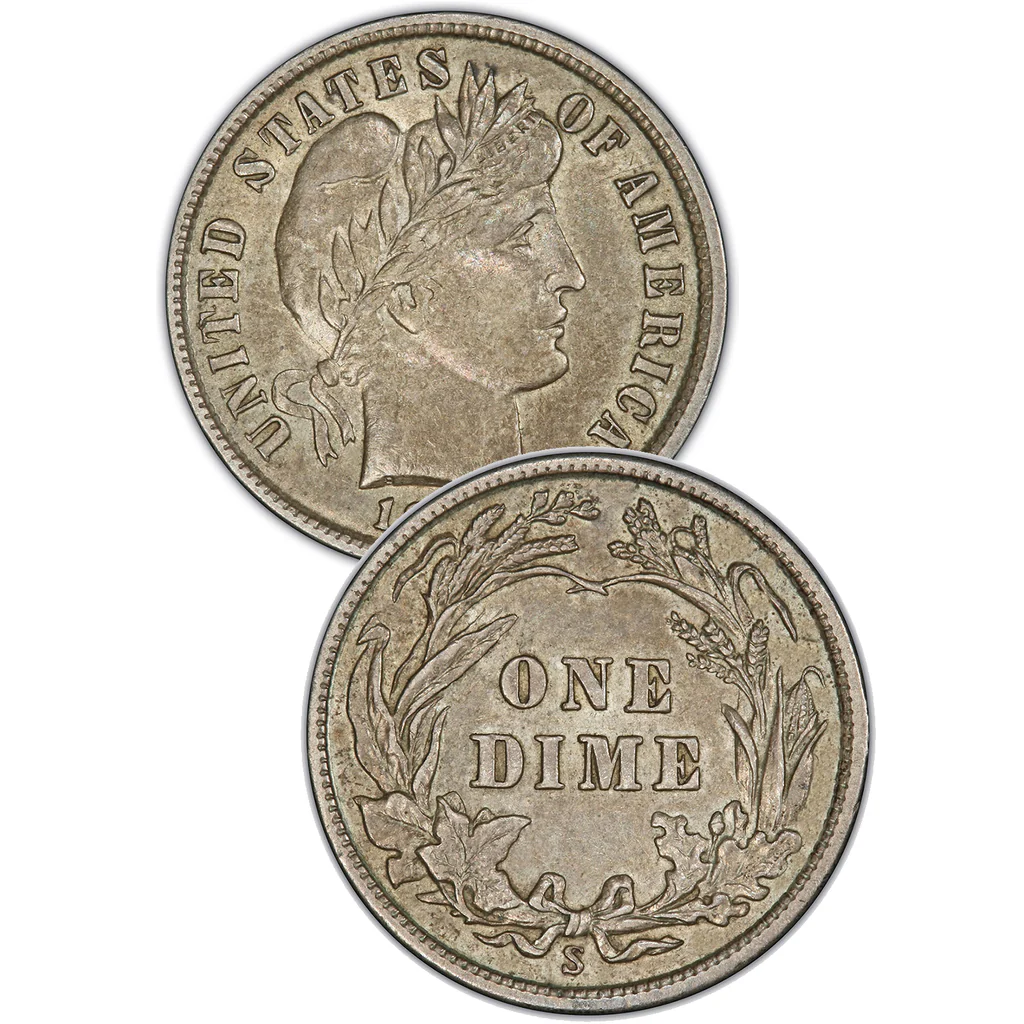
Worn (G–VG, 4–8)
Few or no letters visible in LIBERTY on the headband. Liberty's portrait is outlined but lacks detail. Rim is full but may touch lettering in AG grade. Worth $14–$24 for Philadelphia; slightly more for branch mints. These circulated widely during the Panic of 1893 era and show it.
Circulated (F–VF, 12–35)
Fine: all letters of LIBERTY visible, some weak at base. Very Fine: LIBERTY fully sharp and easily read. Hair above Liberty's forehead shows defined strands. Worth $31–$100 for Philadelphia; $50–$180 for New Orleans and San Francisco. Most surviving 1893 dimes fall in this range.
XF / About Uncirculated (40–58)
LIBERTY crisp and fully defined. Liberty's cheekbone and hair above forehead show only slight wear at high points. Mint luster survives in protected areas (between letters, inside the cap). Worth $73–$600 depending on mint. Significantly scarcer than lower grades — high-grade Barber dimes were rarely saved.
Gem Mint State (MS-64+)
No wear whatsoever. Full cartwheel mint luster visible when tilted under light. High-grade Philadelphia strikes are typically frosty; early San Francisco issues often show prooflike reflectivity. Worth $500–$16,000+ depending on mint and variety. NGC grades fewer than 510 MS examples total across all three 1893 mints combined.
🔍 CoinHix helps you match your coin's condition against graded examples using photo comparison — a reliable on-the-go approach for first-pass grading estimates — a coin identifier and value app.
💰 Where to Sell Your Valuable 1893 Barber Dime
Where you sell matters as much as what you have. The right venue for a $30 circulated dime is different from the right venue for a $5,000 overdate specimen.
🏛️ Heritage Auctions
The world's largest numismatic auction house and the best venue for high-grade or rare 1893 dimes. Heritage regularly sells MS-64+ examples, overdates, and proof specimens to specialist bidders. Their online archives provide the best comparable sale data. Best for: MS-62 and better, overdates, proofs, and errors. Expect a seller's fee of 10–15%.
🛒 eBay / Online Marketplaces
Excellent for circulated 1893 dimes in Good through VF grades where the audience is broad and liquidity is high. Check recently sold prices for 1893 Barber dimes on completed eBay listings to price your coin competitively. Fees run approximately 13–15% combined. Ungraded coins benefit from multiple clear photos showing LIBERTY, mintmark, and date area.
🏪 Local Coin Shop
Convenient for quick sales of circulated 1893 dimes. Expect wholesale offers of 40–60% of retail value — dealers need margin to resell. Useful if you want immediate cash and don't want to handle shipping or online listings. Ask for multiple quotes before committing. A coin shop won't offer a fair price on a major rarity without appraisal.
💬 Reddit r/Coins4Sale
Active community for collector-to-collector sales with no seller fees. Works best for mid-grade circulated 1893 dimes where you've already confirmed the variety and condition. Post clear photos of obverse, reverse, and close-up date/mintmark. Require payment via PayPal Goods & Services for buyer and seller protection. Not suitable for high-value pieces above $500.
❓ Frequently Asked Questions — 1893 Dime Value
How much is a 1893 dime worth?
What is the 1893/2 overdate dime?
Where is the mint mark on a 1893 Barber dime?
What makes the 1893-S dime valuable?
How do I identify the 1893/2 overdate on my dime?
What is the 1893-S/S repunched mintmark?
How many 1893 proof dimes were made?
Should I clean my 1893 Barber dime?
What are the compositions and specifications of the 1893 Barber dime?
What is the rarest 1893 dime error?
Ready to find out what your 1893 dime is worth?
Use our free calculator — no signup required. Just mint mark, condition, and any known variety.
Run the Free Calculator →